
Can You Coat Over a Painted or Already-Coated Garage Floor?
Quick answer: A professional floor coating should not go on top of old paint, a DIY kit or a worn coating. A 100% solids polyurea coating needs to bond to clean, bare concrete, so the old finish is diamond ground off first. If it went over the top, your new floor would only be as strong as the old layer underneath it.
This comes up a lot at estimates around Downriver. Maybe you bought a house in Taylor or Southgate and the garage floor was painted gray years ago. Maybe you rolled on a kit yourself and now it's peeling under the tires. Either way, you want to know if you can just put something better on top.
Here's the honest answer, how to tell what's on your floor right now, and what actually happens to get it ready for a new coating.
Why a new coating can't go over the old one
Think of a floor coating like a bandage. It only holds as well as the skin it's stuck to. A coating doesn't just sit on the floor. It grips the surface it touches. If that surface is old paint, the new coating grips the paint, not the concrete.
The trouble is that you can't see how well that old paint is holding on. It may look fine in one spot and be barely attached a few feet away. Once a new floor is on top, here's what tends to happen:
- The old layer lets go, and takes the new floor with it. Hot tires, freeze-thaw and road salt keep working on the weak spot until it lifts.
- Peeling shows up where you park. Tire paths are where a weak bond fails first. That's the same pattern we explain in hot tire pickup.
- Moisture gets trapped. Old coatings can hold moisture against the slab in ways a new system wasn't designed to handle.
- You end up paying twice. When it fails, both layers have to be removed, and the job gets bigger than it would have been the first time.
Our guide on why garage floor coatings peel goes deeper on this. Almost every peeling floor comes back to the same thing: what happened (or didn't happen) before the coating went down.
How to tell what's on your floor right now
Not sure if your garage floor is bare, sealed, painted or coated? A few simple checks will tell you a lot:
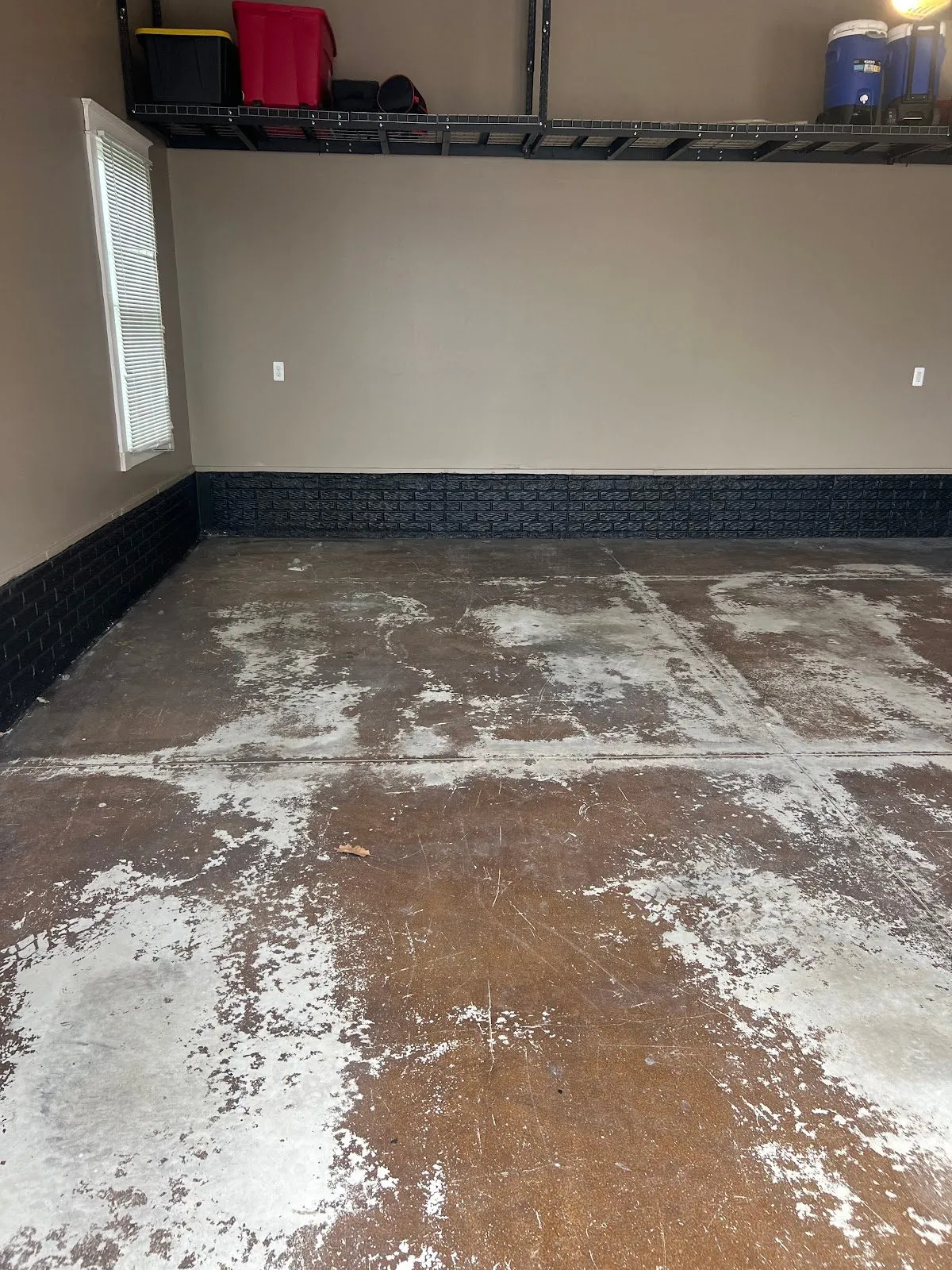
- Look at the color. Bare concrete is a natural, uneven gray. A solid, even color (gray, tan or tile red are common in older Michigan garages) usually means paint or a coating.
- Do the water drop test. Pour a little water in a few spots. If it soaks in and darkens the concrete within a few minutes, the slab is probably bare. If it beads up and sits there, something is on the surface. Our guide to concrete sealers and floor coatings explains why sealers matter here too.
- Check the edges and the tire paths. Flaking, bubbles or bare patches where the car parks are signs of an old finish that's already letting go.
- Look for a sheen. A glossy or satin shine on an older floor usually means a sealer or coating, even if it's clear.
- Ask about the history. If you bought the home recently, the seller or inspection report may mention what was done to the garage floor.
You don't need to figure it out perfectly. Joe checks this at every estimate. But knowing a little ahead of time helps you understand the plan and the quote.
What happens to the old finish during prep
Every Fortified floor starts with diamond grinding. On a bare slab, grinding opens up the surface so the base coat can bond into the concrete. On a painted or coated floor, that same step does double duty. It removes the old finish and opens up the concrete underneath.
- Assess the old finish. We look at what's there, how well it's stuck, and how thick it is.
- Grind it off. Diamond grinding removes the old paint or coating down to clean, sound concrete.
- Repair the slab. Old coatings sometimes hide cracks, pits and salt damage. Once they're exposed, they're repaired. Read more in can you coat a cracked garage floor.
- Clean up the dust. The floor is vacuumed so nothing sits between the concrete and the base coat.
- Install the new system. A 100% solids polyurea base coat, decorative flakes, and a clear, UV-stable polyaspartic topcoat.
You can see the grinding step up close in our concrete grinding video, and why prep matters so much in not all garage floor coatings are the same.
A note for older Downriver homes
A lot of homes in Allen Park, Lincoln Park, Wyandotte and Southgate were built decades ago, and some garage floors have been painted more than once. The EPA notes that homes built before 1978 may have lead-based paint. If your garage floor paint could be that old, it's worth having it tested before anyone grinds it, so it can be handled the right way.
The same idea applies inside the house. Older basements often have tile, carpet glue or black mastic that needs testing and removal first. We cover that in old tile, carpet glue and black mastic on a basement floor.
Old floors can still turn out beautifully. Watch this 30-year-old Allen Park garage floor transformation, or see our Allen Park garage floor coating page.
What about touching up a floor that's already coated well?
Not every existing coating is a problem. If you have a professionally installed flake floor that's still well bonded and just looks dull or scuffed, it may be possible to clean it, lightly sand the surface and add a fresh topcoat. That's a different job from covering old paint.
Whether that works depends on the condition of the coating, so it needs to be looked at in person. If the old coating is peeling, bubbling or lifting anywhere, it's not a candidate for a topcoat. It needs to come off.
What to ask any installer
If you're getting quotes on a floor that's painted or coated now, these questions help you compare. They fit right in with our list of questions to ask when comparing quotes:
- Will you remove the old paint or coating, or go over it?
- How will you remove it, and is that included in the price?
- What happens if you find cracks or damage underneath?
- Does my home's age mean the old paint should be tested first?
- If you suggest a topcoat instead of a full removal, why is my floor a good fit?
If an installer says they can roll a new coating right over your old paint with no grinding, that's a red flag. It might look good at first. It won't stay that way through a Michigan winter.
Frequently asked questions
Can I just scuff up my old garage floor paint and coat over it?
No. Scuffing only roughs up the paint, and the new coating would still be stuck to the paint instead of the concrete. If the old paint lets go, the new floor goes with it. The old finish needs to be ground off down to clean, sound concrete first.
How do I know if my garage floor has a sealer on it?
Try a simple water drop test. Pour a little water on a few spots. If it soaks in and darkens the concrete within a few minutes, the slab is probably bare. If it beads up and sits on top, there's likely a sealer or coating that will need to come off before a new floor goes down.
Does removing an old coating add a lot of time to the job?
It depends on what's there and how well it's stuck. A thin, worn paint usually comes off with the normal diamond grinding step. Thicker or well-bonded coatings take more work. Joe will look at your floor at the estimate and tell you exactly what your floor needs.
Start fresh and love your garage again
An old painted or peeling floor isn't a dead end. It just needs the right prep. Joe will look at what's on your floor, check the concrete underneath, and give you a clear plan with a straightforward quote. Book your free in-home estimate, learn more about our residential floor coatings, or call or text (734) 600-9542.