
Concrete Staining vs. a Flake Floor Coating: What Holds Up in Michigan
Quick answer: Concrete stain adds color to the concrete itself. It looks great on smooth, clean slabs indoors, but it doesn't cover stains, pits or cracks, and it needs a sealer on top that wears and has to be renewed. A flake floor coating builds a new, thick surface over the concrete that hides old damage and stands up to tires, salt and daily use. Stain is a look. A coating is a look plus protection.
Stained concrete shows up all over Pinterest: warm browns, deep blues, a marbled look like old leather. If your garage or basement floor is gray and tired, it's natural to wonder whether stain is the easy fix. Here's how staining works, where it does well, where it struggles in Michigan homes, and how it compares to a full flake coating.
How concrete stain works
There are two basic kinds:
- Reactive (acid) stains react chemically with minerals in the concrete. The color develops as the reaction happens, which gives that mottled, variegated look. The trade magazine Concrete Decor explains that the final color depends on the slab's porosity, how much stain goes on, and even temperature, humidity and airflow during application (Concrete Decor on reactive stains). In other words, every slab comes out a little different.
- Water-based stains and dyes soak into the surface and give more even, predictable color in a wider range of shades.
Either way, stain is a color, not a protective layer. It's almost always finished with a sealer so the color doesn't wear away or soak up dirt.
Where staining looks great
Stain can be a good choice when:
- The concrete is smooth and in good condition. Stain is translucent, so the slab's surface shows through.
- The space is indoors with light traffic. Think finished basements used as living space, studios or retail floors.
- You love a natural, one-of-a-kind look. The variation that makes stain unpredictable is also what people like about it.
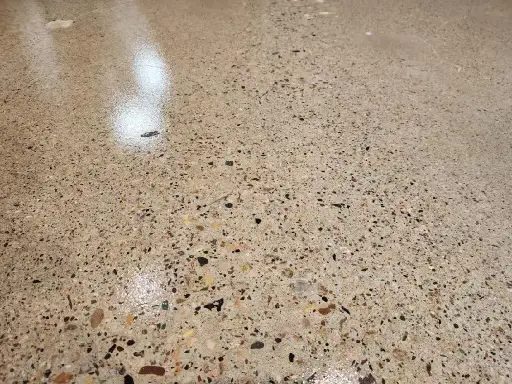
- It's paired with polishing. Stain and polishing are often combined for a sleek, low-maintenance indoor floor. We cover polished concrete on our concrete polishing page.
Where staining struggles in Michigan homes
Most Southeast Michigan garages and basements aren't the clean, smooth slabs stain wants.
It shows everything underneath. Oil stains, tire marks, old paint, patched cracks and pitting all show through the color. Older Downriver slabs from the 1950s and 60s often have years of all of these.
The sealer is the weak point. Stain itself sits in the concrete, but the sealer over it takes the abuse. In a garage, hot tires, road salt and melting snow wear that sealer down. Once it's worn, salty water reaches the concrete again, and the stained surface can start to scale and flake just like bare concrete. Our post on road salt damage shows what that looks like.
It doesn't stop dust or make cleaning easy. A stained, sealed floor is easier to clean than bare concrete, but it's still a fairly thin surface. It won't feel like a finished floor the way a coating does.
Basement moisture can affect the result. Moisture moving through a basement slab can interfere with both the stain and the sealer. Check your slab first using the steps in our basement floor coating guide.
How a flake coating is different
A flake coating starts where stain stops. Instead of coloring the concrete, it covers it.
At Fortified, every floor is diamond ground, cracks and pits are repaired, and then we apply a 100% solids polyurea base coat, a full broadcast of decorative flake, and a UV-stable polyaspartic topcoat. That builds a thick, non-porous surface on top of the slab.
What that means for you:
- Old damage is hidden. Repairs and stains disappear under the flake.
- Salt and water stay on top. Melted snow and road salt never reach the concrete.
- It stands up to cars. The system is built for hot tires, dropped tools and daily traffic.
- The color is consistent. You choose from 24 flake blends, and the flake is broadcast evenly across the whole floor.
- It's warrantied. Manufacturer lifetime warranty against UV fading and a 15-year manufacturer warranty against chipping, peeling and delaminating.
Side-by-side
| Feature | Concrete stain + sealer | Flake floor coating |
|---|---|---|
| What it is | Color in the concrete, sealed on top | New bonded surface over the concrete |
| Hides stains, pits and cracks | No | Yes |
| Color result | Varies slab to slab | Consistent flake blend you choose |
| Holds up to hot tires and salt | Depends on the sealer | Yes |
| Upkeep | Reseal per manufacturer | Sweep and mop |
| Best fit | Smooth indoor slabs, light traffic | Garages, basements, patios, shops |
Which should you choose?
Stain may be right if your concrete is smooth and clean, the space is indoors with light traffic, and you love a natural, variegated look.
A coating is usually the better fit if it's a garage, the slab is older or damaged, you deal with salt and slush every winter, or you want a floor that's easy to keep clean for the long haul.
Polished concrete is a third option for indoor spaces where you want a sleek, natural concrete look without a coating. See how it compares in polyurea vs. grind and shine.
Frequently asked questions
Is stained concrete good for a garage floor?
It can look nice at first, but in Michigan garages the sealer over the stain wears under hot tires, salt and snowmelt. Once it wears, the concrete is exposed again. Most homeowners who want a long-lasting garage floor choose a coating.
Does concrete stain hide cracks and oil stains?
No. Stain is translucent, so stains, patches and cracks show through. A flake coating hides them after the floor is repaired and ground.
Do you have to seal stained concrete?
Stained concrete is almost always sealed so the color doesn't wear away or absorb dirt. That sealer needs periodic renewal according to the product's instructions.
Can you coat over stained concrete later?
Usually, yes. The surface is diamond ground to remove the old sealer and open the concrete so the coating can bond.
What's the most low-maintenance option for a basement floor?
For most Michigan basements, a non-porous flake coating is the easiest to keep clean, as long as any moisture issues are handled first.
See what your floor could look like
If you're weighing stain against a coating, Joe can walk your slab with you, check its condition and talk through colors with you. Book a free in-home estimate or browse our residential floor coatings.