
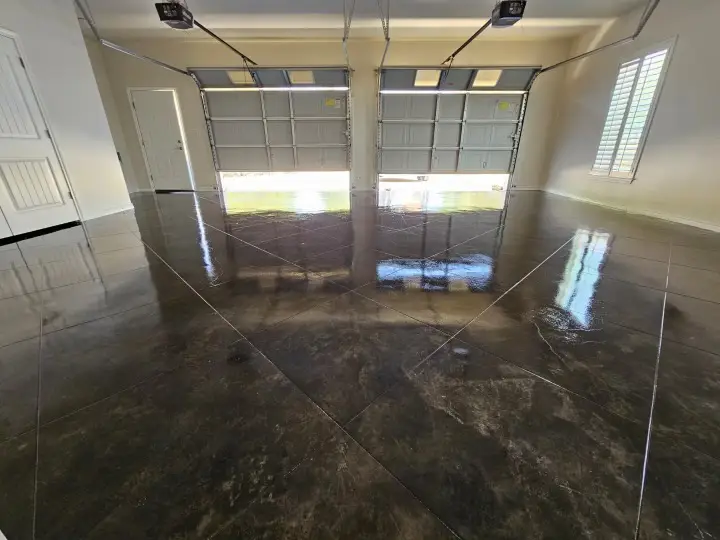
Polished Concrete Floors in Michigan: What Affects the Cost and Is It Right for You?
Quick answer: Polished concrete is your existing slab, ground flat with diamond tooling and refined step by step until it shines. There's no coating on top. The price depends mostly on the condition of the slab, the size of the space, how much of the stone you want to show, and how glossy you want it. It works best indoors in homes, showrooms, offices and warehouses. For salty garages, a coating is usually the better fit.
Polished concrete has moved from big-box stores and warehouses into homes, offices and showrooms across Southeast Michigan. It's durable, it reflects light, and it's easy to keep clean. But two polished floors can look completely different and be priced very differently. Here's what goes into it, so you know what you're comparing when quotes come in.
What polished concrete actually is
Polishing is a mechanical process, not a product you roll on. A machine with diamond tooling grinds the top of the slab flat, then makes pass after pass with finer and finer diamonds, the way sandpaper goes from coarse to fine. A densifier is usually applied along the way to harden the surface. The final passes bring out the shine.
Because the finish is the concrete itself, there's no film to peel or wear through. That's a big part of its appeal.
The two choices that shape your floor
1. How glossy
Industry guides describe four general sheen levels (Concrete Network on polished concrete levels):
- Flat: little to no reflection.
- Satin or honed: a soft, low-sheen, matte look.
- Semi-polished: clear reflections with a little softness.
- Highly polished: near mirror-like.
More gloss means more passes with finer diamonds, which takes more time. At Fortified, you choose your exact finish, from a soft glow to a high-gloss shine.
2. How much stone shows
How deep the grinding goes decides how much of the sand and stone inside the concrete shows:
- Cream: only the top surface, with little to no stone showing.
- Salt and pepper: fine sand specks across the floor.
- Medium or large aggregate: larger stones exposed for a terrazzo-like look.
Deeper cuts take more grinding and can open up small voids that need filling. The construction industry has been working to standardize these terms so quotes are easier to compare (Construction Specifier on standardizing concrete polishing). When you get quotes, ask each company which sheen level and which aggregate exposure they're pricing.
What drives the cost of polished concrete
Every polishing quote is built on the same handful of factors.
Condition of the slab. This is the biggest one. A smooth, sound slab polishes efficiently. Old glue from carpet or tile, paint, sealers, deep stains, cracks and pitting all add grinding and repair time.
Square footage. Larger open floors are generally more efficient per square foot than small rooms with lots of edges and corners.
Sheen and exposure. A satin finish with minimal stone exposure takes fewer steps than a high-gloss floor with exposed aggregate.
Repairs. Cracks, joints and spalled spots need to be filled before polishing. How visible you want those repairs to be affects the approach.
Access and layout. Basements, tight hallways and occupied spaces take more planning than an empty showroom.
Add-ons. Color, dyes or a protective guard on top add steps.
This is why online price-per-square-foot numbers can be misleading. They can't see your slab. Our approach is simple: send a few photos with your quote request, and we'll give you straightforward, honest numbers with no hidden fees.
Where polished concrete makes sense
Showrooms, offices and retail. It looks high-end, reflects light and handles foot traffic. It offers the elegance of stone or tile at a fraction of the cost.
Warehouses and shops. It holds up to heavy traffic and is easy to sweep and scrub. See our commercial floor coatings page if you need a slip-resistant coated system instead.
Finished basements and modern homes. Where the slab is in good shape, polishing gives a clean, contemporary floor with very little upkeep.
Where a coating is usually the better choice
Michigan garages. A garage slab takes road salt, slush, oil and hot tires all winter. A polished floor is dense and durable, but it's still concrete, and a garage floor is usually better off fully covered. A polyurea and polyaspartic coating seals the concrete under a non-porous surface. We compare the two in detail in polyurea vs. grind and shine.
Badly damaged slabs. If the floor is heavily pitted, patched or stained, a flake coating can hide those repairs. Polishing will show more of the slab's history.
Damp basements. Any floor needs the moisture question answered first. Our basement floor coating guide explains how.
Caring for a polished floor
Polished concrete is low maintenance:
- Dust mop or sweep regularly so grit doesn't dull the surface.
- Damp mop with a neutral cleaner made for polished concrete.
- Wipe up spills, especially acidic ones like vinegar, citrus or wine, before they sit.
- High-traffic commercial floors may need periodic re-burnishing to bring the shine back.
Frequently asked questions
How much does polished concrete cost?
It depends on the slab's condition, the size and layout of the space, the sheen level, how much aggregate you want exposed and any repairs. Send us a few photos and we'll give you a straightforward quote for your floor.
Is polished concrete slippery?
A polished floor is generally not slippery when clean and dry. Like any smooth hard floor, it can be slicker when wet, so wipe up spills promptly.
Can any concrete floor be polished?
Most sound slabs can be. Very soft, heavily damaged or very thin concrete may not be a good candidate. Photos are the best first step.
Is polished concrete good for a garage in Michigan?
It can work, but most Michigan garages are better served by a coating that fully covers the concrete against road salt, oil and hot tires.
Polished concrete or a coating for a basement?
If the slab is in good shape and you like the natural look, polishing is a great option. If it's stained, patched or uneven, a flake coating will hide more. Either way, check moisture first.
See what your slab could look like
Send a few photos and we'll show you what's possible, with a straightforward quote and no pressure. Learn more about our concrete polishing or request your free estimate.